
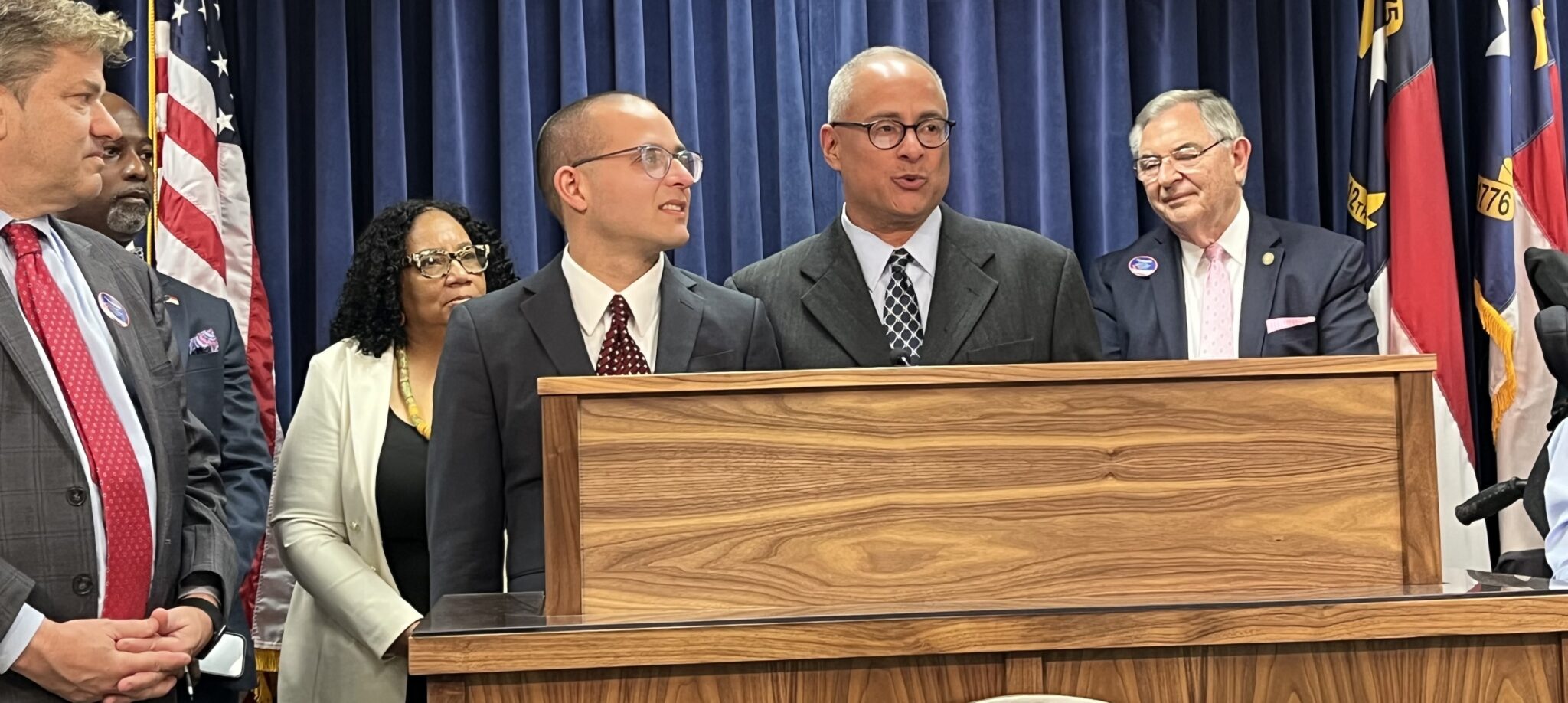
My son Nicholas and I participated in a North Carolina IDD Legislative Caucus Listening Session and a subsequent press conference at the North Carolina State Legislative Building in support of people with intellectual and developmental disabilities.
I was humbled by the stories, passion, insight, and bravery of all the other speakers, including self-advocates and family advocates; impressed by the interest and genuine engagement of many legislators and by leadership from the N.C. Department of Health and Human Services being present; and grateful to LAND, Meet the Need, and the North Carolina Council on Developmental Disabilities, as well as the members of the IDD Legislative Caucus, for the work and commitment involved in putting it all together.
I’ve had several requests for a copy of my statement to the IDD Legislative Caucus about why the Innovations Waiver is so important and why the waitlist for services is so harmful, so I’m posting my remarks here on the site. I wish I could share everyone else’s statements—again, they were wonderful. Above the remarks, I have embedded a video shared by Bethany Smith—you can read along if you want to!
Below the text of my statement, I share a carousel of photographs from the day, as well as links to some of the news coverage the event received.
My name is Ray Hemachandra, and this is my son Nicholas Hemachandra. Nicholas is a kind, loving, and entirely good man. He’s 24 years old. We live together in an apartment in Arden in Buncombe County, North Carolina, and we are here to describe the powerful difference the Innovations Waiver can make in the life of a person with IDD.
Nicholas is autistic and intellectually disabled. He has severe mixed expressive-receptive communication disorder. He is medically at-risk and immunocompromised—co-occurring conditions are common for people with IDD. He has severe ulcerative pancolitis, and he had a stroke. He had significant self-injuring behaviors as a child, behaviors that escalated when he was bullied in school by other children.
Nicholas began receiving the Innovations Waiver, which was then called a CAP waiver, in 2010. He’s now had direct care workers who connect him in the community for 15 years. Having Medicaid also means his medical complications can be addressed appropriately.
Innovations has been an incredible success story for Nicholas. His direct care workers gave him more solid ground to stand on. They supported him in his education and schoolwork, and he graduated from high school with a diploma. Now, Nicholas is part of the paid staff at Annie B’s, a local ice cream shop and visually structured workplace. He volunteers at MANNA FoodBank and Asheville-Buncombe Community Christian Ministry—his volunteering expanded even more for 5 months after Hurricane Helene to help out his community and people in need.
Nicholas learns skills for greater independence with his support workers, from running laundry and doing dishes to self-care skills. He participates in Asheville City recreational programs and other social groups, swims and takes classes at the Y, and he has become a truly exceptional juggler. His Innovations support workers contributed to all of this.
Nicholas is very friendly—he considers everyone a friend—and he connects with people easily. When Nicholas and I are out in the community, people often recognize him and are excited and happy to see him. Many times, these are people I’ve never met before. He has his own life outside of mine.
Nicholas deserves full credit for the man he’s become, but he’s had the opportunity to become that man in large part because of all the support from his Innovations Waiver and amazing care workers.
What is now exceptional about his life is that he received the waiver as a child—he was 9. During childhood, supports and services can have the biggest impact—that’s when truly life-changing shifts are most likely to happen. But the waitlist means children with IDD in North Carolina almost never receive these supports.
In fact, if we continue to create waiver slots at the same rate we have for the past decade, people now toward the end of the almost 19,000-person waitlist will wait roughly 80 years before receiving an Innovations Waiver slot. Most will die first.
But the point of the Innovations Waiver isn’t just getting it, like winning a prize or hitting a jackpot. The point of the Innovations Waiver is for children and adults with IDD to have better, healthier, safer, and happier lives.
The Samantha R. remedy order, set aside because of DRNC’s consent settlement, gave the state 10 years to end the waitlist. That strikes me as a smart starting point for creating a strategic and operative plan to end the waitlist for the Innovations Waiver.
People with IDD are truly the most vulnerable North Carolinians. They make up a disproportionate part of our homeless population. They experience sexual assault and violence at horrifying rates. They often become substance dependent. Too often they live desperate lives, and they die prematurely.
North Carolina can do much better for our children and adults with IDD. We just have to choose to do so. I urge us all to choose to do so. Thank you.
Here is a photo slideshow from the day to click through …
As I wrote to another speaker today: It was a good event—and a great event if we can make sure it helps realize the changes in funding and policy that North Carolinians with intellectual and developmental disabilities need.
News coverage, including these reports (in the order they published or aired), amplified our efforts:
NC does not provide enough support to people with disabilities, families tell legislators, Lynn Bonner, NC Newsline/States Newsroom, March 27, 2025
Disability advocates, families push lawmakers for more services, funding, Rose Hoban, NC Health News, March 27, 2025
19,000 people with disabilities are waiting for services. NC lawmakers seek funding to help, Colin Campbell, WUNC North Carolina Public Radio, March 27, 2025; also here on Blue Ridge Public Radio … both versions have a “Listen” button to hear the piece as it aired on radio.
Advocates push more support for people with disabilities as waiting list nears 19,000, Avi Bajpai, The News & Observer, March 28, 2025
Also, here is a link to an op-ed I wrote that was published last March in The Carolina Journal about the North Carolina waiting list; a parallel piece with a national focus is here on this site:
NC Innovations Waiver is lifesaving for 14k disabled, but 17k others languish on waitlist, Ray Hemachandra, The Carolina Journal, March 18, 2024
Credit/Lack-of-Credit Note: I don’t think I’ve ever posted a slideshow of photos before without knowing the provenance of all the photographs included, but here we are. Broadly speaking, photography credits go to Bethany Smith, Pam Hunter Dempsey and NCCDD, and Beth Field and LAND/Meet the Need. I took a half-dozen of the pics in the carousel. Three photographs are taken from news articles, with these credits: the straight-on photo of Nicholas and me at the press-conference podium is by Lynn Bonner of NC Newsline; the from-the-side capture of Nicholas and me at the table for the legislative listening session is by Ruth Hoban of NC Health News; and the press-conference pic featuring Rep. Zack Hawkins, the IDD Legislative Caucus co-chair, at the podium is by Avi Bajpai of The News & Observer.
Thank you for reading. I invite you to explore some of my articles about autism and intellectual and developmental disability (IDD) on this site, including:
- Autism Adulthood: Caring for the Future and the Present Moment
- Definition as Destiny: Breaking Autistic Boundaries
- Autism and IDD: Caregiving, Advocacy, Community, and Love
- No “Because” but Love—Intellectual Disability, Identity, Representation, and Value
- Poppa, Do You Have Autism?
- Autism Acceptance—and Celebration
- Hammer and Screw: Autism Acceptance and Rejection
- On Blackness and Autism, Identity and Essence
- 7 Values to Live By: Autism Across Schools and Classrooms
- Autism 101: Hating Your Autistic Child
- Accept or Reject: Part one of a series on autism value contrasts
- Autistic Isolation, Connection, and Joy
- My Talk at the 2019 Disability Day of Mourning
