

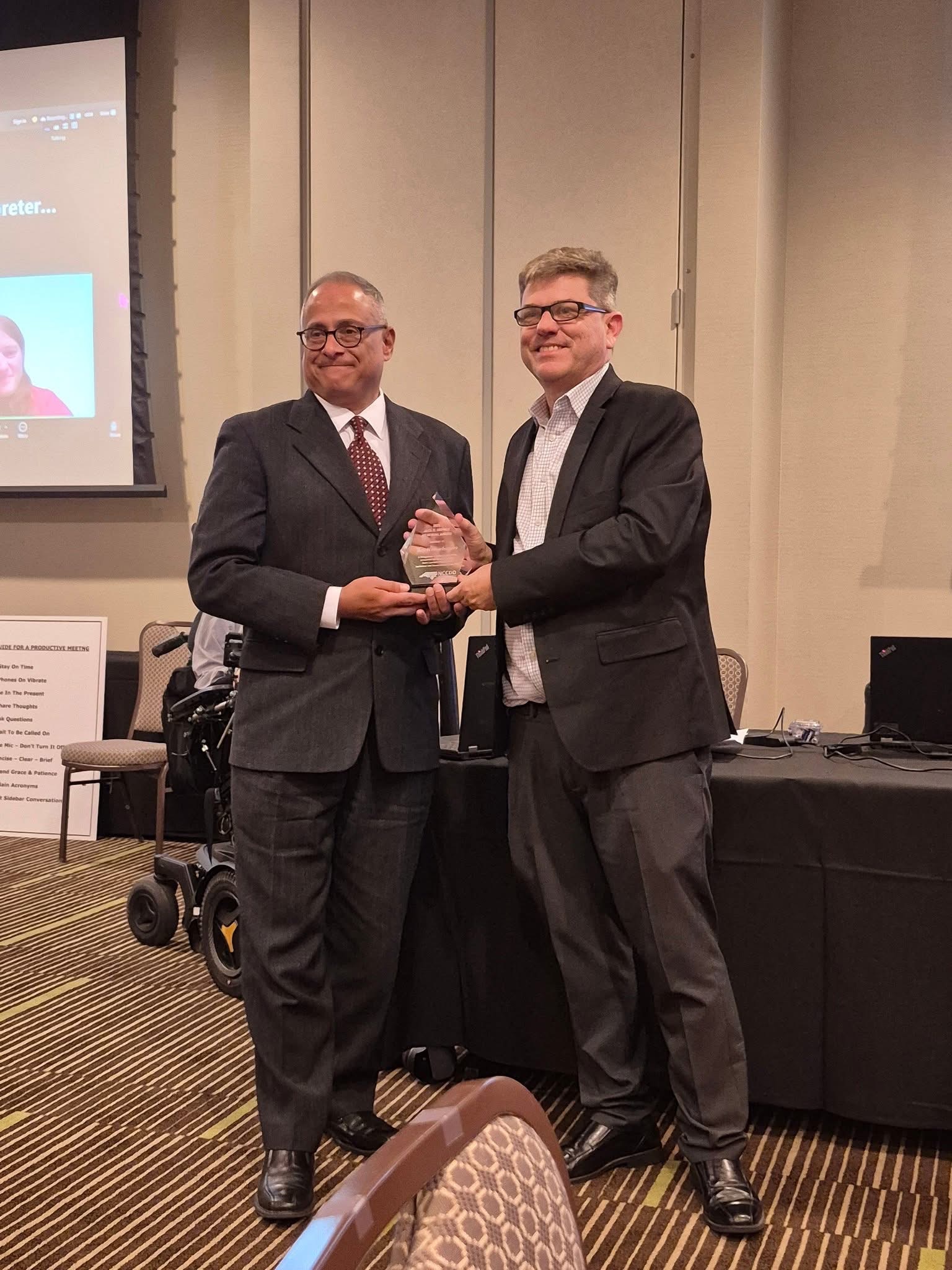
I was honored to receive the Jack B. Hefner Memorial Award this month from the North Carolina Council on Developmental Disabilities (NCCDD).
The Jack B. Hefner Memorial Award—the NCCDD’s oldest award—celebrates advocates who strive for better lives for individuals in North Carolina with intellectual and developmental disabilities (IDD). Here’s the description from the Council: “This award celebrates the vision and achievement of North Carolina’s families and people with IDD. As a father to a son with IDD, Jack B. Hefner—Big Jack—was willing to do whatever it took to enhance the quality of life for North Carolinians affected by disability. Jack B. Hefner’s leadership inspired a generation of advocates and people with IDD to work forcefully. On October 27, 1994, the NCCDD established the Jack B. Hefner Memorial Award to celebrate the vision and achievement of North Carolina’s families and people with IDD.”
At my table for the November ceremony in Raleigh, N.C., were two of Jack Hefner’s sons, Bingham Hefner and Karl Hefner. Karl is intellectually disabled. Bingham shared a story or two about their dad. Both were very kind. Their presence made the evening even more memorable. Our table also included my friends Nancy Baker, Chair of Region 2 of the Vaya Health Consumer & Family Advisory Committee (CFAC) and a Board Director for Vaya Health; Brandon Wilson, the Chief Operating Officer for the Asheville Buncombe Community Christian Ministry and the former chair of North Carolina’s State CFAC; and Ginger Yarbrough, who serves as Chief Clinical Officer–IDD, TBI & Olmstead for the N.C. Department of Health & Human Services.
It is humbling to think about the good work of past Hefner Memorial Award recipients—I’ve worked in various ways with the three most recent winners, for example: Kerri Eaker, Sarah Potter, and Jessica Aguilar—as well as about Big Jack’s personal legacy. I also was pleased to help celebrate the contributions of this year’s other distinguished awardees: Lauren Howard and LaDonna Huffaker, who received the Kerri Eaker Mountain Mover Award; Laura Newell, who received the NC Leadership Achievement Award; and Pat Kuel, who received the Helen C. “Holly” Riddle Distinguished Service Award. Holly Riddle attended the ceremony, as well.
Several people have asked me to share the remarks I made after receiving the award, and I’m happy to do so here. First, you can watch a short introductory video made by the Council that preceded receiving the award; it features Stacy Sorrells, Brandon Wilson, and Nancy Baker, and I’m grateful for their very generous words:
Here are my remarks on Nov. 6 upon receiving the award:
I am honored to receive this recognition, thank you. And I’m so glad two of Jack Hefner’s sons, Karl and Bingham, are here with us this evening.
I first want to thank my son Nicholas, who is autistic and intellectually disabled and amazing. Nicholas is and always has been the heart of my world and my true north. Thank you to the Council; to everyone at Vaya Health for the nomination and especially to Tracy Hayes, Rhonda Cox, and Stacy Sorrells; and to everyone who were references for the award, including several people here tonight.
Thank you, as well, to all the trailblazing disability advocates in whose footsteps we follow—and to all who I get to walk alongside in this work together, now and over the past 20 years, inside organizations and outside of them, inside government and outside of it, and including many of you.
Five minutes would not be enough to name them all. Five days would not be enough to name them all.
So instead I’m going to say three things.
First, in some ways right now is a very challenging time in which the broader political moment, societal directions, and policy and budgetary actions have significant consequence for disability.
But let’s be real about it—it’s always a challenging time for disability.
That said, inclusion, diversity, accessibility, equity, justice—these are all words used in disability movements and advocacy. They are controversial words now.
But we can release the words and still do the work and live the values.
So, we don’t need to say “language justice.” But we do need to improve the availability of information and services for primarily Spanish speaking Hispanic and Latino families that have intellectually or developmentally disabled children. We must do that work.
We don’t need to use the words “racial equity” to provide training to every school teacher and administrator to ensure a Black autistic child’s behaviors are interpreted by schools as potential diagnostic information—as they more commonly would be for a white child or an Asian child—instead of interpreted as malevolent behaviors that need punishment.
To reduce and stop the truly horrific levels of sexual violence against intellectually and developmentally disabled women and girls, we don’t need to use the word “feminism.” But we still need to take action to stop it, now, with urgency. We need to know that it is happening today, tonight, and it won’t go away by itself.
We can still support a neurodiverse queer or gay or trans or bisexual or questioning teen struggling with gender and sexual identity—and identity of all types—by stepping outside of our political framework and into a human one that involves loving, supportive family and community and that asks for caring, supportive systems.
And we don’t need to say “disability justice” to fight for the 20,000 intellectually and developmentally disabled people waiting for the Innovations Waiver in North Carolina. But for all people working in support of children and adults with disabling intellectual or developmental conditions, including traumatic brain injuries, our first priority every day must be ending people waiting to receive services—or at least turning our state’s waitlist that is measured in decades into one measured in months.
Why release the words?
Because we don’t need to be right. We need to help people in their real lives.
We can find common ground in a shared desire to help people with disabilities—and specifically with intellectual and developmental disabilities.
We can find common ground whether the disabled people in need are rural North Carolinians, veterans, immigrants, Black people whose families have lived here for generations, homeless or unhoused people, people with mental health issues, people using substances or in recovery, or every single other group because every single other group includes adults and children who are intellectually and developmentally disabled.
They are always us.
So we can release the words, but not the obligation and not the urgency. I work in other justice areas where you can’t give up the words without giving up the work. But IDD is truly nonpartisan—Democrats and Republicans and independents are equally likely to have family members with an intellectual or developmental disability. So let’s find our common ground and walk together on it with partners who want genuine rather than performative solutions.
Let’s run together on it.
Let’s also talk about what we’re running toward—that’s the second thing I really want to say. We need a clear vision and then we need to create an action plan with stated goals, steps, strategies, progress markers, and funding agreements to rise up to that vision.
The vision must be rooted in having families, communities, and a state of North Carolina in which well-being, happiness, acceptance, inclusion, friendship, lives filled with love, and personal agency and choice are the norms—the realized expectations—for all children and adults with intellectual and developmental disabilities.
That vision of course means there’s no wait for support services for people to live well in their communities. But that’s just part of it.
The vision includes robust housing options. It includes people receiving good healthcare and good dental care. It means people with intellectual and developmental disabilities are food secure, not food insecure, and that they are not living in poverty and constantly at risk, with no hope or expectation for better.
It means we improve primary and secondary education for everyone by teaching about disability awareness and acceptance and creating robust school cultures of inclusion, belonging, empathy, and lovingkindness that will inevitably extend out into our homes and communities.
Obviously it means that the use of the R word is completely ended, as a measure not of political correctness but just of human decency.
That vision, by the way, is just. It is inclusive, it is diverse, and it is equitable.
It is also necessary, and it is urgent.
We can do this. I think there’s an unspoken, pervasive, Sisyphean assumption that we can’t do this, but we can. It’s a choice—to plan, to work, to act, and to make it happen. We can transform our country, our state, our communities, our schools, our churches, our homes, our families, and ourselves.
Finally, I want everyone to remember—as a disabled person or as the caregiver of one—you are living your life right now.
Living your life happily—with joy—is an act of liberation, to use another one of “those” words … and equally it is a ringing affirmation of disabled value and of disabled possibility.
Let yourself be happy even as you work to lift up and ensure the greater possibility of happiness and well-being for others—every single day as you make it happen and as we make it happen together.
Thank you. Receiving the 2025 Jack B. Hefner Memorial Award means a great deal to me. I am truly honored.
Thank you for visiting my website. I invite you to explore some of my articles about autism and intellectual and developmental disability (IDD) on this site, including:
- Response to 2025 article in The Washington Post: We continue to fail autistic people, across parties and as a country. It’s nothing new.
- 2025 Testimony to the IDD Legislative Caucus at the N.C. General Assembly
- Autism Adulthood: Caring for the Future and the Present Moment
- Definition as Destiny: Breaking Autistic Boundaries
- Autism and IDD: Caregiving, Advocacy, Community, and Love
- No “Because” but Love—Intellectual Disability, Identity, Representation, and Value
- Poppa, Do You Have Autism?
- Autism 101: Hating Your Autistic Child
- Accept or Reject: Part one of a series on autism value contrasts
- Autistic Isolation, Connection, and Joy
- My Talk at the 2019 Disability Day of Mourning Vigil
- 2025 Op-Ed in Beacon Media: N.C. needs to fund support services for all its children and adults with intellectual and developmental disabilities in need
