
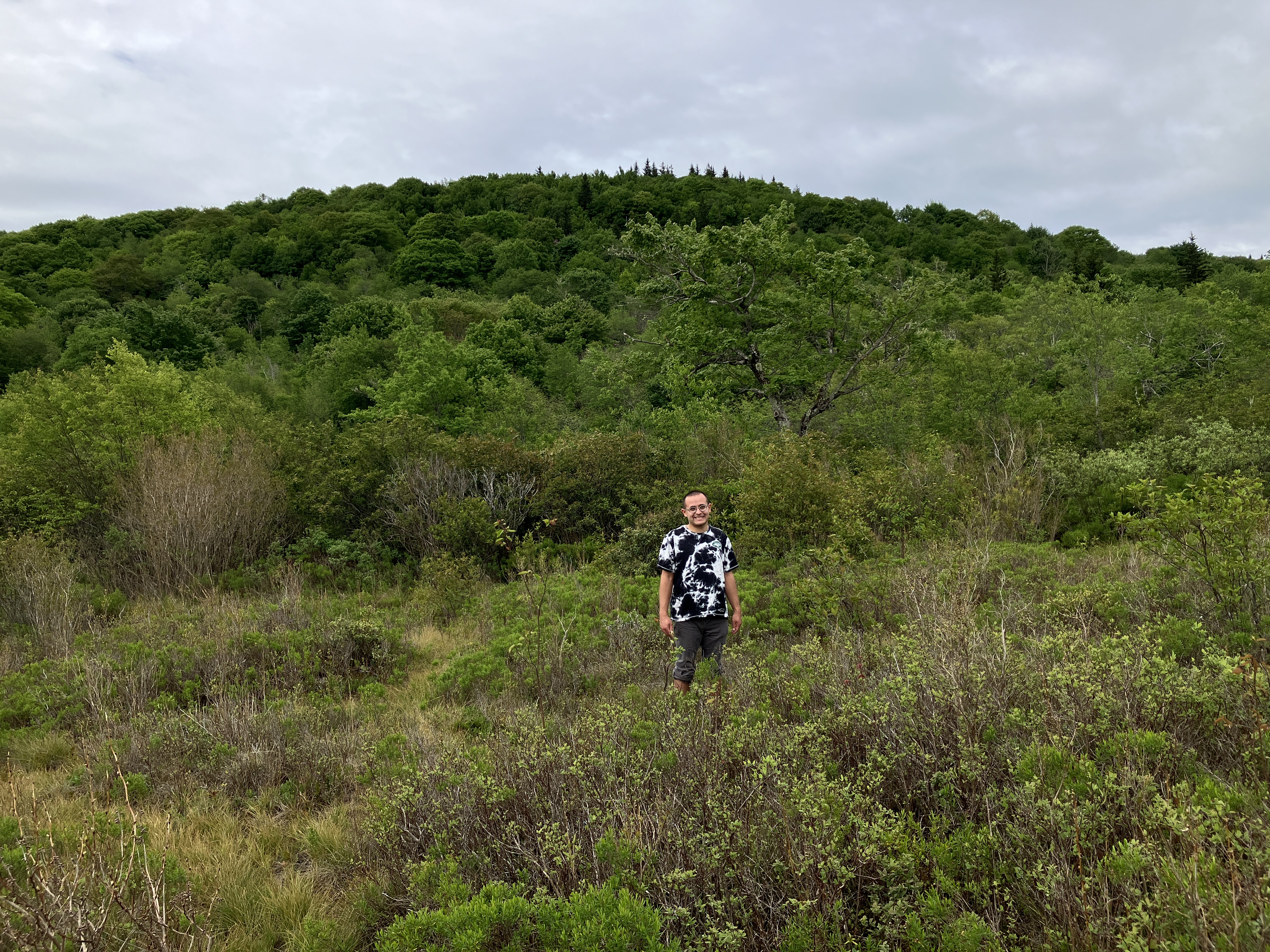
For many years—probably more than a dozen—my son Nicholas and I went on a hike every weekend year-round, rain, snow, or shine.
It started off with me as Nicholas’ caretaker. Eventually, as he carried the backpack of food and often looked back to make sure I hadn’t fallen or fallen behind, he in large part became mine.
Hiking across mountaintops, in forests, or to waterfalls is a source of immense joy for my son—a source of connection to nature and to me. COVID, then a shoulder surgery for me, then Hurricane Helene in western North Carolina, and then the other-shoulder surgery eventually slowed down our hiking cadence and, to some extent, my ambition for which hikes we do.
Nicholas is 25. He is autistic and intellectually disabled.
We went to Graveyard Fields off the Blue Ridge Parkway this past weekend, about an hour’s drive from our front door, on a rainy Saturday in Asheville. The rain signaled that the Parkway wouldn’t be especially crowded—and a little past 9 am, we were one of only three cars in an expanded Graveyard Fields lot that often overflows.
Everything was so beautiful and peaceful, like the old days. I know Nicholas—and I—felt at home.


[Click on a photo to see it at a larger size and to scroll through the full set.]
Hiking is a true love for Nicholas and an essential part of his life.
And that’s a critical thing for caregivers of adults, like Nicholas, who have intellectual and developmental disabilities (IDD): Who will take Nicholas hiking when I’m no longer able to do it? How often—or how rarely—will it happen, if it happens at all?
How often are adults with IDD in group homes, for example—or even adults in supported-living settings—given genuinely meaningful opportunities to get out into nature in this way? And that’s not even addressing disabled people who receive no services at all.
For many adults with IDD, their lives are far too rote, uniform, repetitive, and bleak. They’re living, sure, but far too often they’re not really living the kind of lives they would design or choose.
They’re living lives designed, instead, by a system’s economic and workforce efficiency metrics, sometimes a provider agency’s profit motive, and, often ultimately, the system’s lowest common denominator.
How do we develop better systems of support with far greater ambition, including for honoring individuality—individual preferences and individual agency for designing what a good life looks like and then realizing it, together, as best we can?
Now *that* would be person-centered. But only if we really mean it. Otherwise, “person-centered” is just marketing.
To start, we need to recognize the value and importance of it and then hold ourselves to account with far greater urgency: people with IDD are living their lives right now. They deserve to have joy, connection, love, and agency, just like everyone else, and they deserve it now.
For my son, Nicholas, that means having many more experiences like this weekend at Graveyard Fields, hiking, resting, and being immersed in its natural wonder, its beauty, its peacefulness, and our precious, sacred time with one another.
Please share your thoughts and feedback below. I don’t often note it, but Nicholas read and approved this piece before I made it public—a process we follow for every article in which he has a prominent role.
Visit this page to see a list of some popular pieces I’ve written about autism, as well as intellectual and developmental disabilities more broadly, or click over to these posts for some short stories featuring Nicholas:
- “Poppa, Do You Have Autism?”
- You’re My Son
- Never Met a Stranger: Connection in the 21st Century
- The Egg Chair: Spinning for Speech
- The Autistic Spectacle
