
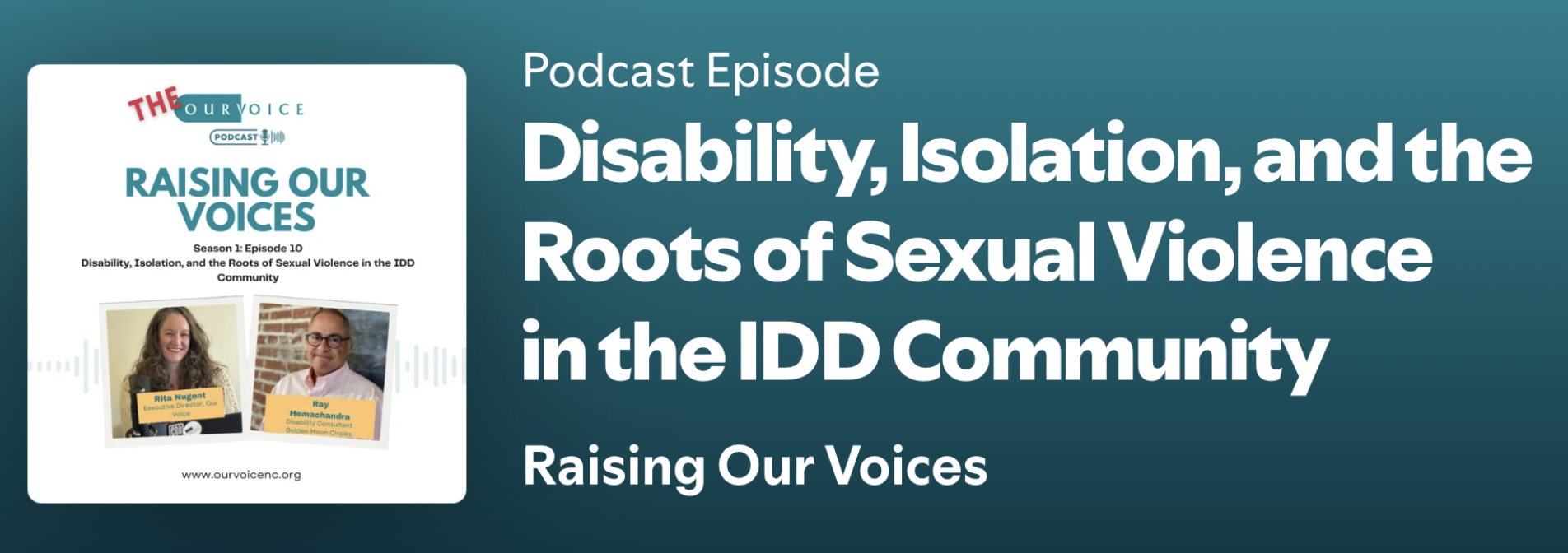
I was honored to be a featured guest for the podcast Raising Our Voices to talk about disability, intellectual and developmental disability (IDD), and the harm pervasive sexual violence causes disabled people.
“Raising Our Voices” is the podcast of Our Voice, a nonprofit in western North Carolina that works to end sexual violence and human trafficking.
As I’ve written about in Reducing Pervasive Sexual and Domestic Violence and Abuse Against People with Intellectual and Developmental Disabilities (IDD), people with intellectual and developmental disabilities—and especially girls and women with IDD—are sexually assaulted at overwhelming, heartbreaking, and enraging rates. Four out of five girls and women who are intellectually or developmentally disabled are sexually assaulted in their lifetimes, and two of them are sexually assaulted more than 10 times.
In this episode of the Raising Our Voices podcast, Our Voice executive director Rita Nugent and I discuss a wide range of issues around this topic, including:
- why there are such extraordinarily high levels of harm for girls and women with IDD and who the perpetrators are
- the dangers of emphasizing compliance to children and adults with IDD
- sexual education unavailability and inaccessibility for people with intellectual and developmental disabilities
- what consent means for someone who is intellectually disabled and who might be disempowered in all other areas of decision making
- how we resist prioritizing the reduction and end of this pervasive sexual violence and trauma because we still regard people with IDD as “less than”—basically, as less than human, lacking sexual needs or desires that other people have, or just not important enough to educate or to protect from harm
Play the podcast right here (or access and listen to this and all episodes of Raising Our Voices here):
A few passages from the podcast
About Consent
What does consent mean for a person with an intellectual disability? That’s a really complicated question. If someone doesn’t have the capacity to make a financial decision in their lives—they have a guardian who makes that decision for them—do they have the capacity to make a decision about a sexual relationship? If someone controls decision-making in all other areas of their life, do they still get to hold it in that area of their life?
Of course, at the same time, people with intellectual and developmental disabilities, or other disabilities, are human beings with as much right and desire to have a full human life as anyone else, and that often includes sexuality for people—and they should get to choose that.
That’s a difficult tension.
About Compliance
Rita Nugent: Sexual violence is about a lack of power and control over your own life, and folks with disabilities who have guardians already don’t have a whole lot of power and control in their lives.
Ray Hemachandra: That’s a really great point. And it brings to mind something that’s important to say—that we teach people with intellectual and developmental disabilities to be compliant.
Rita Nugent: Oh yeah we do. We teach compliance, and we don’t really think about the downside of that.
Ray Hemachandra: For many people with intellectual and developmental disabilities—even in adult life, they carry forward that sense from childhood of wanting approval, wanting to do the right thing. So, “yes” is the answer.
For IDD Professionals
If you know a girl or a woman who’s intellectually disabled or developmentally disabled, the likelihood that they have been or will be sexually assaulted or abused is extremely high. It might well be happening right now.
For professionals—let’s say a direct support professional, a QP, a care manager, a care coordinator, or a community health worker at an organization that participates in the care of people—you need to look at everyone on your caseload, all the people you work with, through that lens.
We don’t do that. And that means we are not doing our best to protect girls and women. We’re not really looking at how we can help keep them safe.
On how girls and women with IDD—and the IDD system—respond to assault
Many people with intellectual disabilities, and some with developmental disabilities, don’t have the capacity to report sexual assault or violence—don’t have the tools to report it. So, the trauma they experience is just in their inner life. It goes to their sense of identity, of self, of safety. It undermines them. It might show up in behaviors, and people around them may not even understand what those behaviors are. They might misattribute them to something else, might start medicating someone without knowing what’s happened, might think it’s part of a diagnosis of autism or another diagnosis—when in fact those behaviors may be a completely reasonable and common response to harm and trauma. …
Please give the full episode a listen! I invite you to leave a comment below with your thoughts, concerns, experiences, and ideas about the episode and about these critically important issues.
Here are a few other articles about intellectual and developmental disability on the site:
- Reducing Pervasive Sexual and Domestic Violence and Abuse Against People with Intellectual and Developmental Disabilities (IDD) (December 2024)
- The Value of Disabled Lives and Organs (January 2022)
- My Talk at the NCCDD Awards Ceremony, upon Receiving the Jack B. Hefner Memorial Award (November 2025)
- End the Waitlists for Services for People with Intellectual and Developmental Disabilities (March 2025)
- Community Inclusion and IDD: Prioritizing and Empowering Choice for the Disabled (June 2022)
- No “Because” but Love—Intellectual Disability, Identity, Representation, and Value (May 2020)
- My Talk at the Disability Day of Mourning (March 2019)
- Serving Hispanic and Latino People with Intellectual and Developmental Disabilities (IDD) (January 2025)
